
Neurofeedback & ADHD: A Look at Research Studies on Brain-Computer Interfaces

Ever feel like your mind is a web browser with too many tabs open? That is what the world of ADHD (Attention Deficit Hyperactivity Disorder) feels like, where it’s a complex disorder that presents challenges to those navigating it due to its intricate relationship with neuronal mechanisms which are characterized by cognitive task difficulty, impulsivity, and hyperactivity. The symptoms of ADHD vary based on the patients’ age of diagnosis and the age at which they receive medical attention.
Children with ADHD are more prone to process things differently from neurotypical kids and possess an imbalance in the dopamine system in which they lack sufficient dopamine. Adults with ADHD may struggle in academic settings, hindering their ability to complete degrees or training programs. In the workplace, focus difficulties and impulsivity can make it hard to stay organized, meet deadlines, or navigate complex social dynamics. These struggles can ultimately lead to negative socio-professional outcomes, impacting a person's career trajectory and overall well-being.
So how do individuals with ADHD receive analysis, evaluation, and feedback to deal with it? Addressing this issue, research on neurofeedback through Brain-Computer Interfaces (BCIs) emerges as a promising therapeutic avenue!
What is a brain-computer interface (BCI) and how does it work?

As of today’s science development, the thoughts in your brain can directly interact with technology and potentially train your neurons.
Brain-computer interfaces (BCIs), also known as brain-machine interfaces (BMIs), are groundbreaking technologies that establish a direct communication pathway between the brain and external devices. Essentially, Brain-Computer Interfaces (BCIs) are like headsets that can read your mind!
One of the primary methods employed to capture and interpret brain signals is electroencephalography (EEG). EEG records a plethora of neural activities, each represented by distinct frequencies, offering a window into the intricate workings of the mind. These frequencies span a spectrum and reflect on the dynamic interplay of various cognitive states and physiological conditions. By deciphering these neural signatures, BCIs hold immense promise in revolutionizing fields ranging from healthcare and assistive technologies to gaming and beyond.
The effectiveness of brain-computer interface (BCI) towards neurological conditions
The effectiveness of brain-computer interfaces (BCIs) relies on precise neural signal acquisition and robust decoding algorithms. It offers promising avenues for addressing the challenges faced by individuals with ADHD, ASD, etc. By leveraging EEG technology and advanced algorithms, BCIs can potentially provide real-time feedback and intervention strategies tailored to the unique neural signatures associated with ADHD. These interventions include attention training exercises, cognitive tasks, or neurofeedback protocols aimed at improving attentional control and focus.
There have been research trials exploring BCI’s that are yielding exciting results, demonstrating their potential to revolutionize treatment for attention-deficit disorders. Below are a few lists of research studies conducting BCI towards ADHD individuals!
Xin Qian et al. BCI CogoLand (2018)

A research team led by Xin Qian examined 66 young boys diagnosed with attention deficit hyperactivity disorder (ADHD), including both combined and inattentive subtypes. The boys were recruited from the Child Guidance Clinic at the Institute of Mental Health in Singapore. Participants were randomly allocated into two cohorts: the intervention group (ADHD-I) and the non-intervention group (ADHD-NI). During the interval between assessments, individuals in the ADHD-I group engaged in an 8-week program of brain-computer-interface (BCI)-based attention game training, consisting of three sessions per week.

Researchers used a machine learning algorithm to analyze brain waves (EEG) to measure attention. People played a 3D game (CogoLand) where their avatar sped up based on their focus. Following the 8-week BCI-based intervention, the ADHD-I group exhibited a notably more substantial decrease in clinician inattention scores according to the ADHD-RS, compared to the ADHD-NI group.
2. Choon Guan Lim et al. BCI (2023)
From 2010 to 2023, Choon Guan Lim et al. have researched and conducted BCI based game experiments towards children with ADHD. In 2012, he and his team analyzed 20 unmedicated ADHD children with an 8-week intensive BCI-based attention training game system with their BCI based game CogoLand. These researchers tested a BCI that uses comfortable sensors, dry electrodes, to measure attention.
In 2023, Researchers developed a tablet program paired with a wireless EEG headset to train attention. They tested it on 20 med-free kids with ADHD, half doing the program at home and half in a clinic. Everyone was able to use the tablet program easily with minimal assistance.
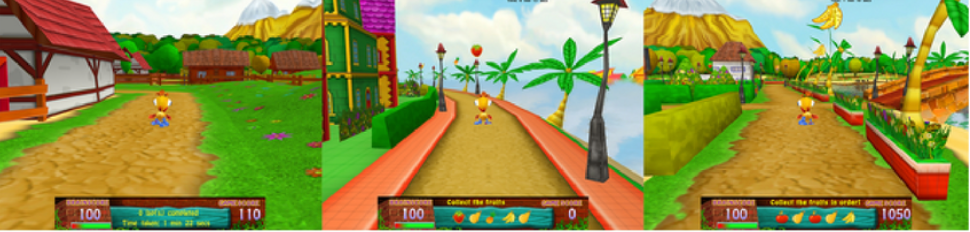
The results were promising! After treatment, children with ADHD were much better at focusing and parents have reported their kids were less hyperactive and impulsive too. These improvements lasted for several months as long as the children kept practicing with the BCI game once a month.
3. Alchalabi et al. FOCUS (2018)

Alchalabi et al. Introduced FOCUS, an EEG-controlled game aimed at addressing attention deficits in individuals with ADHD. By wearing an EEG headset (EMOTIV-controlled), players can control the movements of an avatar within the game solely through their focus and mental commands, allowing for the measurement and amplification of attention levels. The study’s results showcased the efficacy of this approach, demonstrating accuracy in classifying attention states for both healthy participants and those with ADHD.
4. Rohani et. al (2015)

Researchers Rohani, Puthusserypady, and Sorensen explored using virtual reality (VR) classrooms to improve attention in people with ADHD. Their idea was to leverage a brain signal called P300, detected by a brain-computer interface (BCI) device, as a way to track attention. They created special attention games within a 3D VR classroom to test this. The key here was making it affordable and easy to use. They developed a special "off-axis perspective projection" system that didn't require expensive equipment and could be set up in classrooms, homes, or even clinics.
The findings of the study suggested promising results for using VR classrooms as a means to enhance attention in individuals with ADHD. When participants with ADHD were exposed to sights and sounds that would normally distract them in the VR classroom, their P300 brain signals improved, suggesting heightened attention that VR classrooms could be a promising new tool for helping people with ADHD focus and pay attention, offering a fun and engaging way to address attention challenges in this population!
Conclusion:
ADHD can be a persistent challenge that follows individuals into adulthood. This can have significant negative impacts, affecting their ability to succeed in school, work, and social settings. While ADHD can be a lifelong challenge, neurofeedback using Brain-Computer Interfaces (BCIs) offers a promising approach to managing symptoms.
The international landscape of neurofeedback research offers a diverse array of perspectives, methodologies, and clinical contexts, enriching our understanding of its applicability and generalizability across populations and cultural settings. Neurofeedback through Brain-Computer Interfaces (BCI) games leverages real-time monitoring of brain activity to enable individuals to self-regulate neural patterns associated with ADHD and other attention-deficit symptoms, thereby promoting improved attentional control and behavioral modulation.
Despite its promise and advancements, further research is needed to address challenges such as variable brain signals, limited data transmission capacity, and extensive user training.
Have questions and thoughts about neurofeedback, BCI and ADHD? Leave a comment below and we’ll get back to you!
Written by Kyrana Thian
Kyrana Thian is currently a 16 year old highschool student chasing her passion through neuroscience and surgery, computer science and digital education. She heavily thrives to be productive and contributes to make a great impact in her community.



Comments